
Field report:
A better way to clean heat exchangers
From a difficult, noisy and messy work environment to a well-organized job with reduced noise and improved safety. This is the story of a pilot project in the Netherlands, where we tested a Safety Funnel prototype for a vertical heat exchanger – a solution designed to contain spray, water and debris during cleaning.
The project was carried out together with Peeters Nederland B.V., the contractor, and DERC Salotech, supplier of water jetting equipment, at a factory in the Netherlands. Peeters had been assigned to clean vertical heat exchangers – a type of job they had carried out many times before.
The challenge
“The debris and dirty water flies everywhere. It becomes very, very messy.”
Normally, Peeters starts by shielding off the work area with safety ribbon, creating a safety zone of six meters around the operation. The operators wear full PPE, but no other physical barriers are built. For this type of cleaning, Peeters typically uses high-pressure rotating nozzles, a runner tube spinner type, to clean the inside tubes of heat exchangers, operating at pressures of around 1,000 bar.
Anyone working with heat exchanger cleaning knows that they can be packed with sand, dirt, and other debris. During water jetting, water and debris exit from the bottom, creating spray and potentially ejecting dirt, particles and plugs like stones at high velocity.
– You have maximum spray when the water comes out from the heat exchanger. The debris and dirty water flies everywhere. It becomes very, very messy, says Kees Kimenai, Project Manager at Peeters.
The water and dirt are collected in a large bin placed below the heat exchangers, but the spray still spreads around the surrounding area. A vacuum truck is needed to collect the wastewater and contamination, and the whole area must be cleaned with low-pressure washers. The clean-up alone usually takes between one and one and a half days, resulting in additional labor costs and potential downtime in that part of the facility.
Another major issue is the sound. When the water exits the heat exchanger, the noise level is very high. It creates a sharp sound that echoes throughout the factory.
– Heat exchanger cleaning often needs to be performed while normal operations continue around it. That creates challenges not only for the operators carrying out the work, but also for production personnel and other people working nearby, says Kees Kimenai.
The solution
“Once the cleaning started, the effect was clear, and the difference was remarkable.”
The project started as a custom-made solution. While TST’s Safety Funnel is already an established solution for horizontal heat exchanger cleaning, no version had yet been developed for vertical heat exchangers.
The Safety Funnel is a durable textile containment solution that attaches directly to the heat exchanger. During cleaning, it captures water, spray and debris and guides the wastewater into a collection bin below, helping to create a cleaner, safer and more controlled work environment.
To fit the vertical heat exchangers that Peeters had been assigned to clean, a custom-designed Safety Funnel was developed for this pilot project. The installation was straightforward. Due to the size of the heat exchanger, two people were needed, and the Safety Funnel was installed in approximately five to ten minutes.
– Once the cleaning started, the effect was clear, and the difference was remarkable.
The water, dirt and spray were collected inside the Safety Funnel and guided down into the bin underneath. Nothing escaped into the surrounding work area. Everything was contained in the funnel and then collected in the large bin, where it could be removed by vacuum truck. The clean-up afterwards took only one hour, says Jorgen Niemantsverdriet, International Account Manager at DERC Salotech.
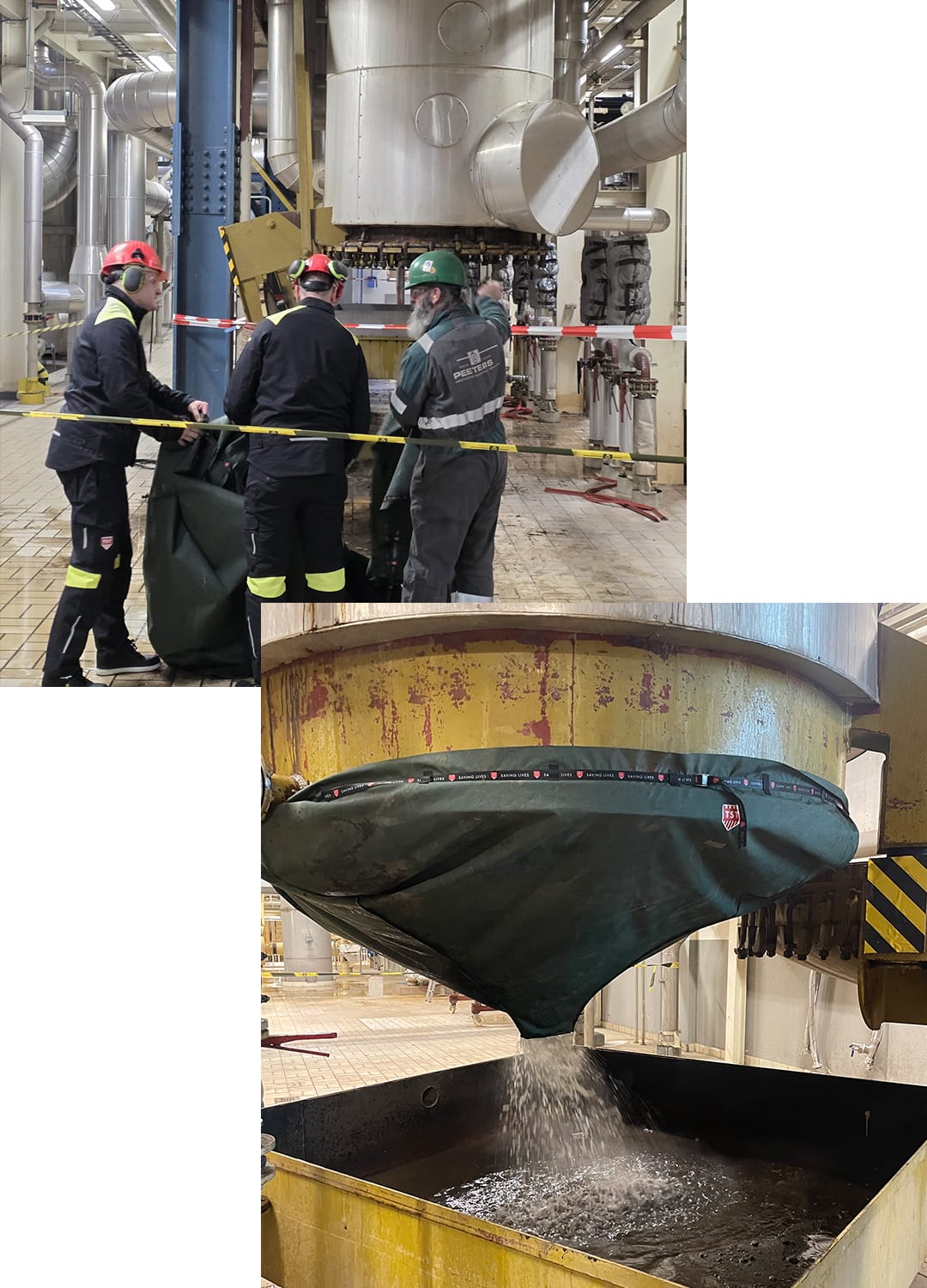 The Safety Funnel was installed in just a few minutes. Water, dirt and spray were collected inside the Safety Funnel and guided down into the bin underneath.
The result
The Safety Funnel made the work safer in several ways. It controlled the spray coming out from the heat exchanger and helped collect dirty water, debris and small particles like stones inside the funnel instead of letting them spread into the surrounding work area. This reduced the risk of material being ejected at high speed and made the whole cleaning operation more controlled.
– The sound was another important improvement. With the Safety Funnel, everyone was very happy with the reduced noise level. The sharp, echoing sound that normally spreads throughout the factory was significantly reduced, creating a better working environment not only for the operators, but also for other people working at the site, says Kees Kimenai.
Peeters, the contractor, and the factory owner were all very satisfied with the result. For the factory, the main benefits were noise reduction and reduced contamination inside the plant as well as a significantly faster overall process. For Peeters, the biggest improvements were safety, control and the clean-up afterwards. Peeters would definitely recommend TST Safety Funnels to others, and also internally within the Peeters group.
What had previously been a messy, noisy and difficult job became a controlled operation with clear benefits:
- Controlled wastewater collection
- Reduced contamination inside the plant
- Noise reduction
- Faster clean-up afterwards – 1 hour instead of 1,5 days.
- A cleaner and safer working environment
- Less need for extensive shielding
- Reduced disturbance to other work in the factory
 Jorgen Niemantsverdriet from DERC Salotech and Peder Lindström from TST Sweden all agreed that the project was a great success.
Proven concept
It started as a custom-made project and ended as a successful pilot project with clear benefits for everyone involved.
– Peder Lindström from TST and I visited the site to understand what type of Safety Funnel was needed for the job. Within a short time, TST delivered the Safety Funnels for the vertical heat exchangers. TST then visited the site again to make sure everything worked as intended and that the project was successful, says Jorgen Niemantsverdriet.
– We listen to the needs of the market. We are constantly looking for innovations and ways to solve the problems our customers face. Working close to the operators is an important part of that process. By being present when the cleaning is carried out, we can understand the real challenges and develop solutions that make a practical difference, says Peder Lindström at TST Sweden.
According to Peder Lindström, the pilot project also confirmed that the Safety Funnel concept works just as well for vertical heat exchangers as it does for horizontal applications.
– We can see that this Safety Funnel for vertical heat exchangers does the same good job as our horizontal Safety Funnels for heat exchangers – when it comes to safety, cleaning efficiency and noise reduction, says Peder Lindström.